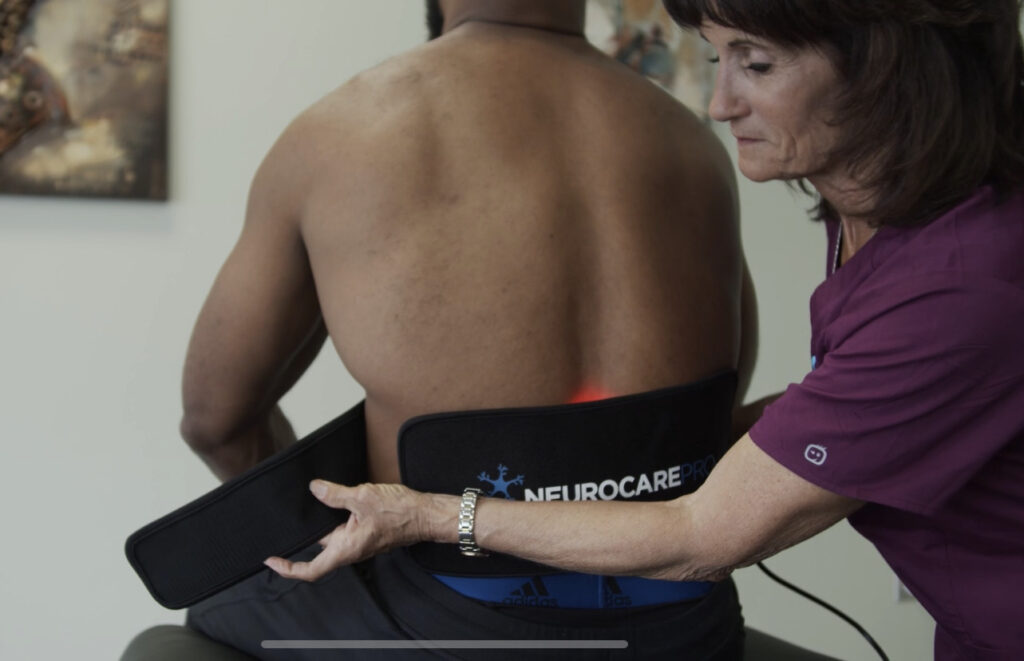
Cellular Mechanisms
Scientific investigations reveal that PBM specifically enhances stem cell regenerative potential via the following core mechanisms:
- Proliferation & Viability: Multiple studies utilizing mesenchymal stem cells (MSCs) have shown that 600–900 nm light irradiation (particularly red and NIR) increases cellular proliferation rates and maintains high viability, which are prerequisites for effective tissue integration. Fekrazad et al. quantified upregulation of cell cycle regulators (e.g., cyclin D1) and anti-apoptotic proteins following PBM, promoting stem cell survival during transplantation and engraftment.
- Migration: Ma et al. demonstrated that PBM augments MSC migration via induction of Akt phosphorylation—a cellular pathway critical for cytoskeletal rearrangement and directional movement toward injury sites. Enhanced migration ensures stem cells localize efficiently to damaged tissues, expediting reparative cascades.
- Differentiation: Photobiomodulation precisely influences lineage specification in stem cells. Osteogenic differentiation, vital for bone and joint healing, is upregulated by PBM through the activation of BMP-2 and Runx2 gene expression. Similar evidence exists for neuronal and chondrogenic differentiation when stem cells are exposed to tailored PBM parameters (energy density, pulse frequency).
- Immunomodulation & Anti-inflammatory Response: PBM reduces inflammatory cytokine expression (e.g., TNF-α, IL-6, IL-1β) while simultaneously promoting anti-inflammatory M2 macrophage phenotypes. For example, Ebrahimpour-Malekshah et al. reported synergistic suppression of inflammation and acceleration of wound closure when diabetic rat wounds were treated with both PBM and adipose-derived stem cells.
- Angiogenesis: PBM stimulates secretion of vascular endothelial growth factor (VEGF) and matrix metalloproteinases, pivotal for blood vessel formation. Mulaudzi et al. found that PBM exposure enhances adipose-derived stem cell angiogenic potential, leading to improved tissue oxygenation and nutrient delivery.
Key Pathway Modulation Diagram
- PBM → Cox activation → ↑ATP, ↓ROS
- PBM + Stem Cell → ↑Proliferation, ↑Migration, ↑Differentiation → Enhanced Tissue Repair
Addressing Specific Conditions: Study Integration
Bone Regeneration
- Fekrazad et al. and Ma et al. elucidate PBM’s ability to potentiate osteogenic differentiation of MSCs, resulting in denser bone, increased mineralization, and accelerated graft healing. Direct modulation of osteogenic markers such as ALP, COL1A1, and OPN underscore these findings.
Wound Healing
- Ebrahimpour-Malekshah et al. conducted controlled trials in rats with diabetic wounds that received PBM alone, stem cells alone, and combination therapy. Healing rates, granulation tissue formation, and angiogenesis markers were significantly higher in the combination group, confirming potent synergy in dermal and vascular repair.
Nerve & Neurodegenerative Repair
- PBM supports neural differentiation and axonal outgrowth, as shown by Abrahamse & Crous: immortalized adipose-derived stem cells exposed to PBM developed more robust neural markers (Tuj1, MAP2) and formed complex neuritic networks, indicating PBM’s utility in neurological therapies.
Anti-Inflammation & Fibrosis
- PBM therapy has consistently reduced fibrotic tissue and chronic inflammation in stem-cell-treated models, aligning with deep immunomodulatory changes observed at cellular and transcriptomic levels.
Optimizing PBM Therapy: Precision Matters
- Dosimetry: Dose-response studies (e.g., Khorsandi et al.) confirm an optimal PBM energy density between 1–10 J/cm² for stem cell modulation, with both sub- and supra-optimal dosing attenuating benefits.
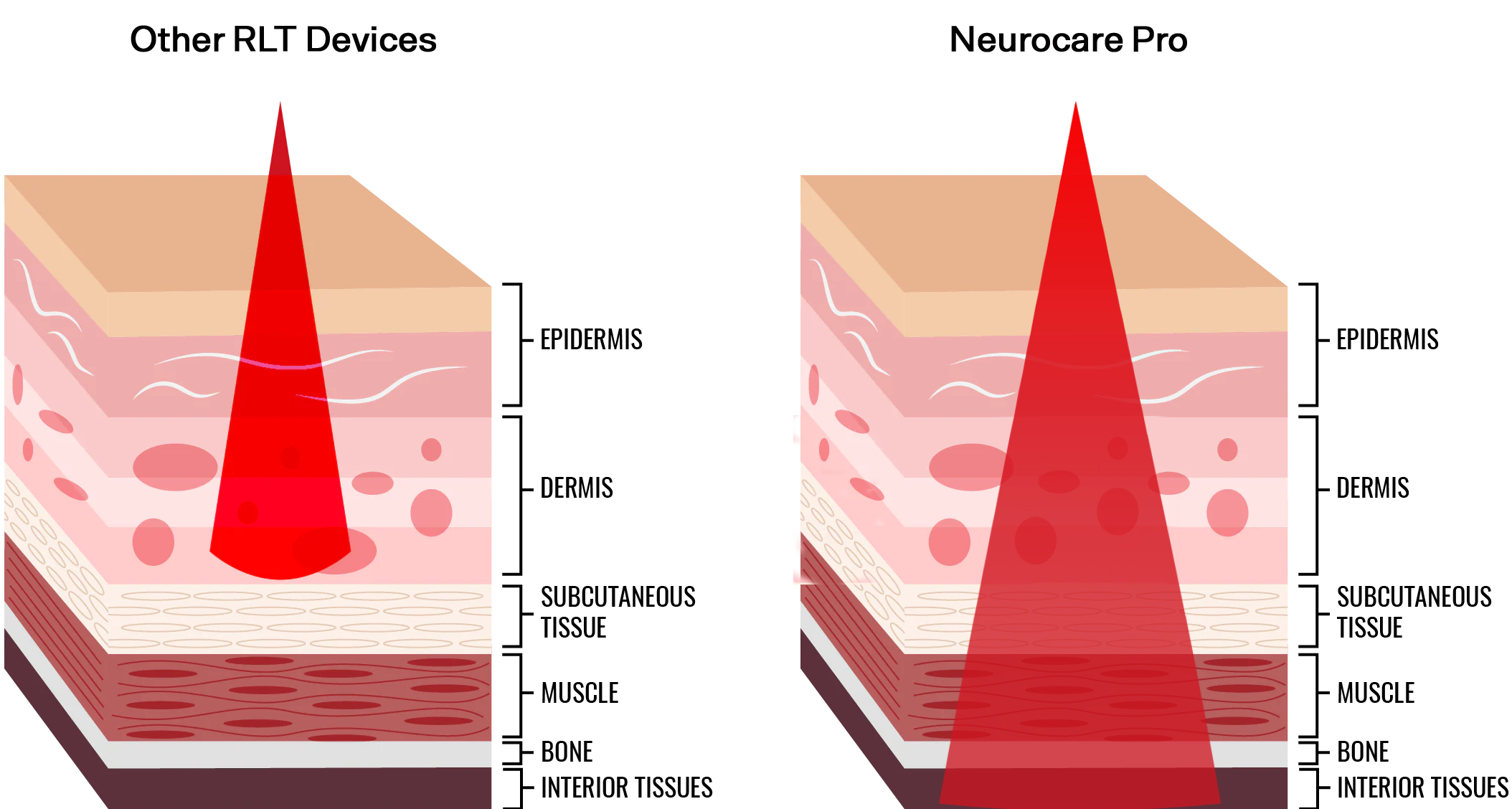
- Spectral Engineering: Red (630–670 nm) and NIR (810–880 nm) wavelengths show the greatest tissue penetration and mitochondrial activation effects.
- Pulse Modulation: Pulsed light with frequency variation yields superior cellular entrainment and reduces risk of overstimulation, differentiating advanced systems from basic continuous output devices.
NeurocarePro PLMT™: Technology Advancements
NeurocarePro’s Pulsed Light Medical Technology (PLMT™) exemplifies these scientific foundations, substantially outperforming average RLT/NIR systems in several critical domains:
- Spectral and Frequency Diversity: Employing polychromatic, frequency-tuned light (Nogier, Solfeggio) excites multiple cellular targets simultaneously—mitochondria, ion channels, and cell membrane receptors—amplifying tissue oxygenation, ATP synthesis, and NO-mediated vasodilation.
- SMD Web-Based Diode Arrays: Proprietary triple-chip SMD arrays deliver uniform, broad-coverage irradiation at low thermal load, expanding the treatable area and depth without compromising safety.
- Neurovascular Integration: Hamblin and Henderson/Morries demonstrated that frequency-coded NIR pulses (similar to PLMT™) especially benefit cerebral oxygenation, mitochondrial respiration, and neuroplasticity, enhancing cognitive outcomes even in advanced neurodegenerative disease.
- Clinical Translation: Controlled studies with PLMT™ modalities report marked improvements in executive function, fine motor control, sleep quality, and mood stability versus standard PBM, attributable to the system’s integrated approach to neurovascular harmonization and cellular recovery.
PLMT™ Advanced PBM vs. Standard PBM Systems
| Feature | Neurocare Pro’s PLMT™ Advanced PBM Systems |
Standard RLT/NIR Systems |
|---|---|---|
| Wavelengths | Multi-spectral, polychromatic delivery (RLT & NIR) | Mono-spectral, Single/alternating monochromatic delivery |
| Pulse/Frequency | Frequency modulated (Nogier, Solfeggio: 1-9999Hz) | Continuous, repetitive laser (or through-hole) diode |
| Coverage | Broad-area, versatile, SMD LED pads | Focused, narrow beams |
| Thermal Profile | Cool, non-thermal | Occasional localized heating |
| Penetration | Enhanced vasodilation; deeper | Limited, shallow stimulation |
| Regenerative Effect | Systemic, multi-pathway | Local, Symptom-targeted |
Clinical and Home Application: Safety and Usability
NeurocarePro’s PLMT™ therapy systems are engineered for clinical and home use, boasting:
- Non-invasive, non-thermal delivery for safety across age groups.
- User-friendly hardware facilitating high patient compliance and easy integration into care pathways.
- No reported adverse effects after extensive hospital use.
Explore NeurocarePro’s Systems and Care Verticals
View our full range of clinically validated PLMT™ care vertical systems developed for cerebral, neurological, orthopedic, accelerated wound-healing, pain management and versatile applications. Each system is designed to deliver cutting-edge results and measurable improvements for practitioners and patients alike. NeurocarePro makes personalized, evidence-based therapeutic solutions accessible to every care setting, elevating patient health and clinical excellence.
Recommended Systems:


References and Further Reading:
- Fekrazad, R., et al. “Effect of Photobiomodulation on Mesenchymal Stem Cells.” Photomedicine and Laser Surgery, vol. 34, no. 11, 2016, pp. 533-542.
- Ma, C., Ye, Y., Shi, X., et al. “Photobiomodulation Promotes Osteogenic Differentiation of Mesenchymal Stem Cells and Increases P-Akt Levels In Vitro.” Scientific Reports, vol. 15, 2025, p. 17844.
- “Photobiomodulation for Stem Cell Modulation and Regenerative Medicine.” WALT Position Paper, 2025.
- Mulaudzi, P. E., Abrahamse, H., and Crous, A. “Impact of Photobiomodulation on Neural Embryoid Body Formation from Immortalized Adipose-Derived Stem Cells.” Stem Cell Research & Therapy, vol. 15, 2024, p. 489.
- Ebrahimpour-Malekshah, R., et al. “Combined Therapy of Photobiomodulation and Adipose-Derived Stem Cells Synergistically Improve Healing in an Ischemic, Infected, and Delayed Healing Wound Model in Rats with Type 1 Diabetes Mellitus.” BMJ Open Diabetes Research & Care, vol. 8, no. 1, 2020, e001033.
- Harrington, Phil. “Synergistic Effects of Photobiomodulation and Stem Cell Therapy: Clinical Applications and Outcomes for Medical Doctors.”
“Photobiomodulation Dose–Response on Adipose-Derived Stem Cell Osteogenesis in 3D Cultures.” International Journal of Molecular Sciences, vol. 25, no. 17, 2025, p. 9176. - Abrahamse, H., and Crous, A. “Photobiomodulation Effects on Neuronal Transdifferentiation of Immortalized Adipose-Derived Mesenchymal Stem Cells.” Lasers in Medical Science, vol. 39, 2024, p. 257.
- “The Science Behind Red Light Therapy and Stem Cell Production.” Deeply Vital Medical.
- Khorsandi, K., et al. “Biological Responses of Stem Cells to Photobiomodulation Therapy.” Current Stem Cell Research & Therapy, vol. 15, no. 5, 2020, pp. 400-413.
- Tang, Luyao, et al. “Effects of Pulsed Red and Near-Infrared Light on Neuroblastoma Cells—Pilot Study on Frequency and Duty Cycle.” Photonics, vol. 10, 2023, p. 315.
Additional Sources:
- https://pubmed.ncbi.nlm.nih.gov/40403870/
- https://drphilharrington.com/my-laser-articles/synergistic-effects-of-photobiomodulation-and-stem-cell-therapy-clinical-applications-and-outcomes-for-medical-doctors
- https://drc.bmj.com/content/8/1/e001033
- https://www.sciencedirect.com/science/article/pii/S1572100025007690
- https://pmc.ncbi.nlm.nih.gov/articles/PMC7206914/
- https://journals.sagepub.com/doi/10.1089/pho.2015.4029?int.sj-abstract.similar-articles.10
- https://www.jkslms.or.kr/journal/download_pdf.php?doi=10.25289%2FML.2022.11.3.134
- https://pmc.ncbi.nlm.nih.gov/articles/PMC6983866/
- https://pubmed.ncbi.nlm.nih.gov/37243832/
- https://onlinelibrary.wiley.com/doi/full/10.1002/INMD.20240013
- https://www.mcgill.ca/oss/article/medical-critical-thinking/hype-around-photobiomodulation
- https://www.jkslms.or.kr/journal/view.html?uid=202&vmd=Full