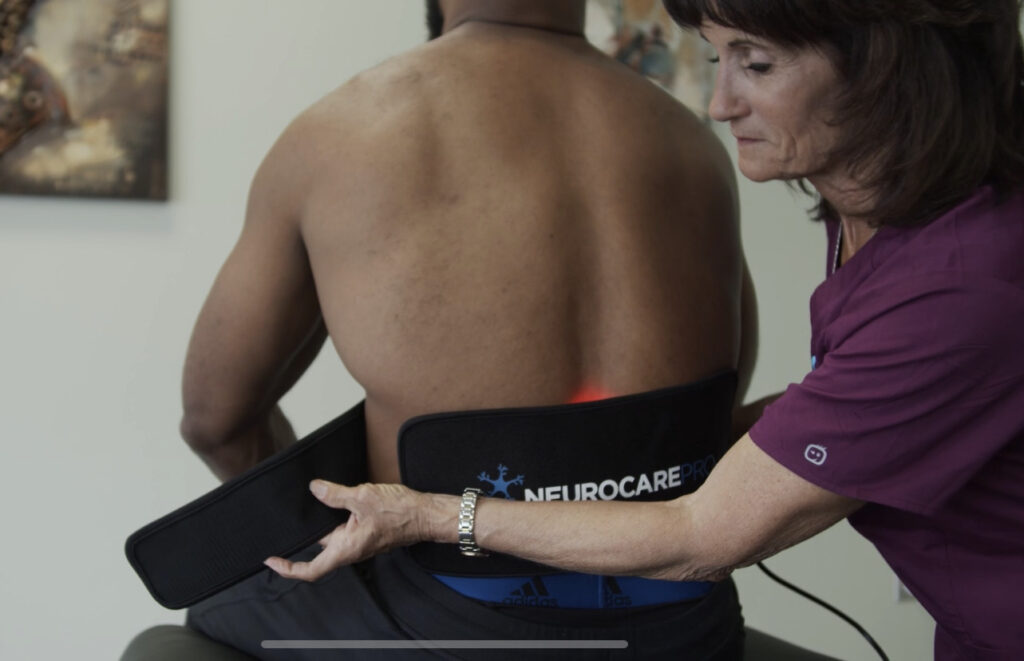
How PBM Works with Stem Cells
Studies show that PBM directly affects stem cell activity through several biological mechanisms:
- Proliferation and viability: PBM light boosts the number and survival rate of stem cells, allowing more cells to participate in healing.
- Migration: PBM encourages stem cells to move more effectively to the damaged tissue where they are needed most.
- Differentiation: PBM can guide stem cells to develop into specific tissue types. For example, some wavelengths promote osteogenic differentiation—the process by which stem cells become bone-forming cells.
- Gene and pathway modulation: PBM influences how genes inside stem cells are expressed, leading to changes in cell metabolism, repair signals, and growth factors. These effects stimulate anti-inflammatory and angiogenic (new blood vessel formation) pathways, which support faster recovery.
- Anti-inflammatory effects: PBM also helps regulate immune cells such as macrophages—cells that clean up damaged tissue and coordinate the healing response. It promotes the conversion of inflammatory macrophages into M2 macrophages, which calm inflammation and encourage tissue repair.
When combined with stem cell therapy, PBM helps create an environment where stem cells thrive, survive longer, and integrate more effectively with surrounding tissues.
What Research Shows
Clinical and laboratory studies confirm these benefits across a variety of conditions:
- Bone regeneration: PBM-treated mesenchymal stem cells enhanced bone formation in animal models, suggesting benefits for fractures and bone graft healing.
- Wound healing: When PBM is used with adipose-derived stem cells (stem cells from fat tissue), wounds, especially those in diabetics, heal faster with less scarring.
- Nerve repair: PBM improves stem cell survival and their ability to form neural tissue, showing promise for neurodegenerative and spinal cord conditions.
- Inflammation control: PBM’s impact on immune balance supports recovery from chronic inflammation and fibrosis (scarring).
Factors That Influence PBM’s Effectiveness
For best results, PBM must be applied using the right combination of parameters:
- Dose: Too little light may have no effect, while too much can be ineffective or overstimulating.
- Wavelength: Different colors of light penetrate and interact with tissues differently. Red and near-infrared light are most commonly used because they reach deeper tissues and stimulate cell energy production.
- Energy density and exposure time: The total energy delivered per area and duration of exposure determine how stem cells respond.
- Light source: Both lasers and LEDs can be used for PBM, depending on clinical goals.
Further research is focusing on optimizing these parameters to ensure consistent and predictable outcomes.
The Future of Combined Therapy
By integrating light-based PBM therapy with stem cell treatments, clinicians can potentially unlock faster, more effective tissue repair with fewer complications. Ongoing studies continue to confirm the synergistic effects of these therapies—meaning that their combined power is greater than the sum of their parts.
While standardized guidelines are still in development, the growing evidence shows that PBM can safely and powerfully enhance the regenerative potential of stem cells, offering a brighter future for tissue repair and recovery.
How NeurocarePro’s Advanced PLMT™ Systems Exemplify Stem Cell Therapies
NeurocarePro’s Pulsed Light Medical Technology (PLMT™) exemplifies these scientific foundations, substantially outperforming average RLT/NIR systems in several critical domains:
- Spectral and Frequency Diversity: Employing polychromatic, frequency-tuned light of both Nogier and Solfeggio frequencies excites multiple cellular targets simultaneously—mitochondria, ion channels, and cell membrane receptors—amplifying tissue oxygenation, ATP synthesis, and NO-mediated vasodilation.jkslms+1
- SMD Web-Based Diode Arrays: Proprietary triple-chip SMD arrays deliver uniform, broad-coverage irradiation at low thermal load, expanding the treatable area and depth without compromising safety.drphilharrington
- Neurovascular Integration: Hamblin and Henderson/Morries demonstrated that frequency-coded NIR pulses (similar to PLMT™) especially benefit cerebral oxygenation, mitochondrial respiration, and neuroplasticity, enhancing cognitive outcomes even in advanced neurodegenerative disease.onlinelibrary.wiley+1
- Clinical Translation: Controlled studies with PLMT™ modalities report marked improvements in executive function, fine motor control, sleep quality, and mood stability versus standard PBM, attributable to the system’s integrated approach to neurovascular harmonization and cellular recovery.
PLMT™ Advanced PBM vs. Standard PBM Systems
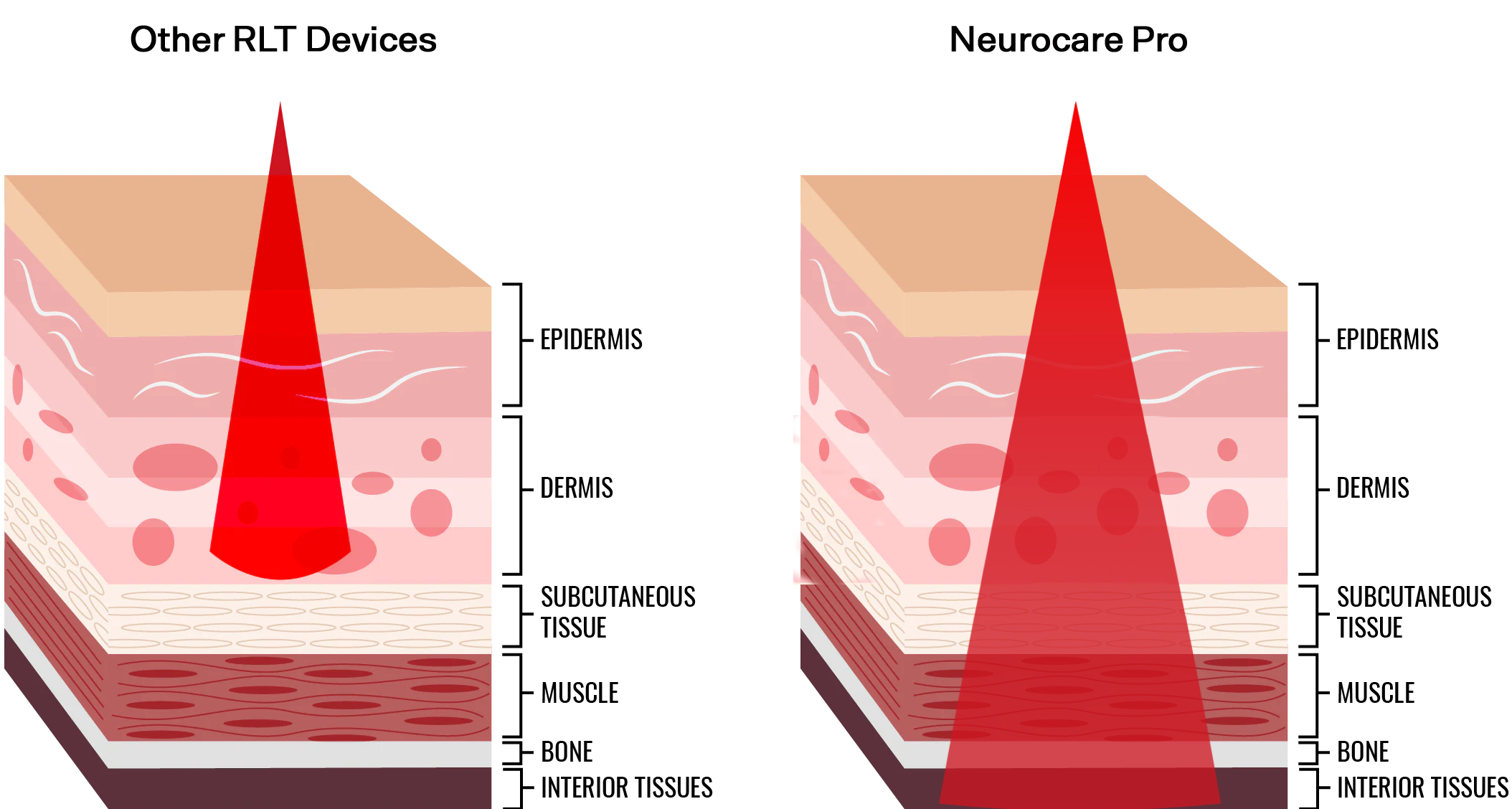
| Feature | Neurocare Pro’s PLMT™ Advanced PBM Systems |
Standard RLT/NIR Systems |
|---|---|---|
| Wavelengths | Multi-spectral, polychromatic delivery (RLT & NIR) | Mono-spectral, Single/alternating monochromatic delivery |
| Pulse/Frequency | Frequency modulated (Nogier, Solfeggio: 1-9999Hz) | Continuous, repetitive laser (or through-hole) diode |
| Coverage | Broad-area, versatile, SMD LED pads | Focused, narrow beams |
| Thermal Profile | Cool, non-thermal | Occasional localized heating |
| Penetration | Enhanced vasodilation; deeper | Limited, shallow stimulation |
| Regenerative Effect | Systemic, multi-pathway | Local, Symptom-targeted |
Clinical and Home Application: Safety and Usability
NeurocarePro’s PLMT™ therapy systems are engineered for clinical and home use, boasting:
- Non-invasive, non-thermal delivery for safety across age groups.
- User-friendly hardware facilitating high patient compliance and easy integration into care pathways.
- No reported adverse effects after extensive hospital use.
Explore NeurocarePro’s Systems and Care Verticals
View our full range of clinically validated PLMT™ care vertical systems developed for cerebral, neurological, orthopedic, accelerated wound-healing, pain management and versatile applications. Each system is designed to deliver cutting-edge results and measurable improvements for practitioners and patients alike. NeurocarePro makes personalized, evidence-based therapeutic solutions accessible to every care setting, elevating patient health and clinical excellence.
Recommended Systems:


References and Further Reading:
- Fekrazad, R., et al. “Effect of Photobiomodulation on Mesenchymal Stem Cells.” Photomedicine and Laser Surgery, vol. 34, no. 11, 2016, pp. 533-542.
- Ma, C., Ye, Y., Shi, X., et al. “Photobiomodulation Promotes Osteogenic Differentiation of Mesenchymal Stem Cells and Increases P-Akt Levels In Vitro.” Scientific Reports, vol. 15, 2025, p. 17844.
- “Photobiomodulation for Stem Cell Modulation and Regenerative Medicine.” WALT Position Paper, 2025.
- Mulaudzi, P. E., Abrahamse, H., and Crous, A. “Impact of Photobiomodulation on Neural Embryoid Body Formation from Immortalized Adipose-Derived Stem Cells.” Stem Cell Research & Therapy, vol. 15, 2024, p. 489.
- Ebrahimpour-Malekshah, R., et al. “Combined Therapy of Photobiomodulation and Adipose-Derived Stem Cells Synergistically Improve Healing in an Ischemic, Infected, and Delayed Healing Wound Model in Rats with Type 1 Diabetes Mellitus.” BMJ Open Diabetes Research & Care, vol. 8, no. 1, 2020, e001033.
- Harrington, Phil. “Synergistic Effects of Photobiomodulation and Stem Cell Therapy: Clinical Applications and Outcomes for Medical Doctors.”
“Photobiomodulation Dose–Response on Adipose-Derived Stem Cell Osteogenesis in 3D Cultures.” International Journal of Molecular Sciences, vol. 25, no. 17, 2025, p. 9176. - Abrahamse, H., and Crous, A. “Photobiomodulation Effects on Neuronal Transdifferentiation of Immortalized Adipose-Derived Mesenchymal Stem Cells.” Lasers in Medical Science, vol. 39, 2024, p. 257.
- “The Science Behind Red Light Therapy and Stem Cell Production.” Deeply Vital Medical.
- Khorsandi, K., et al. “Biological Responses of Stem Cells to Photobiomodulation Therapy.” Current Stem Cell Research & Therapy, vol. 15, no. 5, 2020, pp. 400-413.
- Tang, Luyao, et al. “Effects of Pulsed Red and Near-Infrared Light on Neuroblastoma Cells—Pilot Study on Frequency and Duty Cycle.” Photonics, vol. 10, 2023, p. 315.
Additional Sources:
- https://pubmed.ncbi.nlm.nih.gov/40403870/
- https://drphilharrington.com/my-laser-articles/synergistic-effects-of-photobiomodulation-and-stem-cell-therapy-clinical-applications-and-outcomes-for-medical-doctors
- https://drc.bmj.com/content/8/1/e001033
- https://www.sciencedirect.com/science/article/pii/S1572100025007690
- https://pmc.ncbi.nlm.nih.gov/articles/PMC7206914/
- https://journals.sagepub.com/doi/10.1089/pho.2015.4029?int.sj-abstract.similar-articles.10
- https://www.jkslms.or.kr/journal/download_pdf.php?doi=10.25289%2FML.2022.11.3.134
- https://pmc.ncbi.nlm.nih.gov/articles/PMC6983866/
- https://pubmed.ncbi.nlm.nih.gov/37243832/
- https://onlinelibrary.wiley.com/doi/full/10.1002/INMD.20240013
- https://www.mcgill.ca/oss/article/medical-critical-thinking/hype-around-photobiomodulation
- https://www.jkslms.or.kr/journal/view.html?uid=202&vmd=Full